




Posted: 04/24/2025
The early 2020s were a tumultuous period for federal student loan repayment. Official government policy vacillated between forgiveness, the introduction of lenient repayment terms, and returning to business as usual. Frequent, often drastic, change united schools and borrowers in confusion.
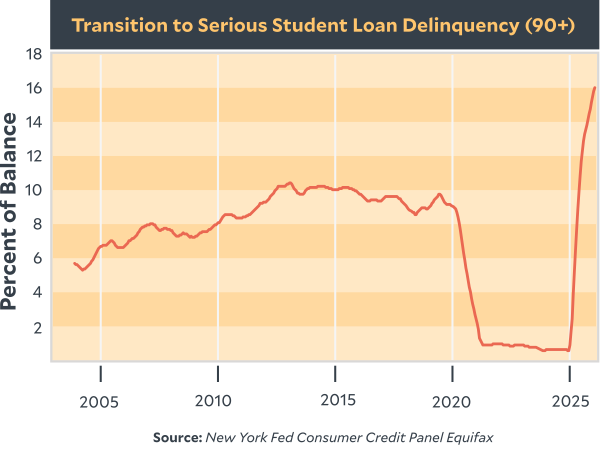
Then 2025 happened. Student loan delinquency rates rose to record highs, and the repayment system was completely rewritten.
In the aftermath, schools find themselves facing major challenges and additional government oversight. To prepare for the future, we must take a hard look at the past and survey the transformed landscape of higher education.
In 2023, Student Connections laid out the challenges facing borrowers returning to repayment, the inadequate resources available to them, and the consequences of ignoring the problem . We could shield our client schools and their students from the fallout, but had no power to address the systemic issues.
During late 2024, an estimated 28 million borrowers flooded the under-resourced student loan repayment system. Loan servicers struggled to convey accurate information to their borrowers, causing even more confusion. Traditional support systems (built to assist a steady trickle of students entering repayment) buckled under the massive number of confused and desperate borrowers seeking guidance. Forty percent of borrowers missed their first payment.
By February of 2025, the U.S. Department of Education (ED) had stopped assessing servicers’ accuracy and monitoring call quality.
This was our worst-case scenario, and the results were catastrophic. Delinquency rates hit all-time highs in 2025. By the end of the year, 7.7 million borrowers had defaulted on their loans. That number grew to 9.2 million by March 2026, with an additional 2.4 million accounts in late-stage delinquency.
While the total delinquency rate dropped slightly in early 2026, it remains at emergency levels. Unless millions of borrowers are guided into repayment plans they can afford, the repayment crisis of 2025 will become the default crisis of 2026.
The Biden administration’s SAVE Plan has died a thousand deaths. It was paused in July 2024, ruled illegal in February 2025, and shuttered by ED in December 2025. In February 2026, it was revived for one week before being shut down for good. As of March 2026, borrowers cannot apply for SAVE, and existing applications are being denied.
All SAVE borrowers must switch repayment plans by the end of September 2026. ED has already notified them of this requirement. Starting July 1, 2026, federal loan servicers will begin issuing a final warning to this group, giving them a final, 90-day window to select an alternate plan.
Our article, “Navigating the End of SAVE in 2026,” provides guidance to SAVE borrowers caught up in the chaos. Please share it with your former students.
The 8th U.S. Circuit Court of Appeals’ decision against SAVE had a surprising impact on the Income-Contingent Repayment (ICR) and Pay as You Earn (PAYE) plans. Each had their loan forgiveness mechanism stripped out, effectively kneecapping them.
Borrowers may still apply for ICR and PAYE, but both plans will be eliminated on July 1, 2028. Enrollees must switch repayment plans by this date or ED will assign them to one.
Income-Based Repayment (IBR) is the last IDR plan standing. Because its forgiveness component was created through an act of Congress, it is immune to the court’s ruling. IBR remains an option for borrowers with existing loans, but will be barred to those with new loans disbursed on or after July 1, 2026.
A portion of 2025’s sprawling One Big Beautiful Bill Act (OBBBA) completely remakes student loan repayment. It eliminates the Extended and Graduated plans, schedules the ICR and PAYE plans to sunset in 2028, and creates two new plans: the Tiered Standard Repayment Plan and Repayment Assistance Plan (RAP).
This restructuring aims to simplify the selection of a repayment plan. Even after the SAVE Plan was eliminated, borrowers still had six to choose from. Students with loans disbursed on or after July 1, 2026, will be limited to either Tiered Standard or RAP.
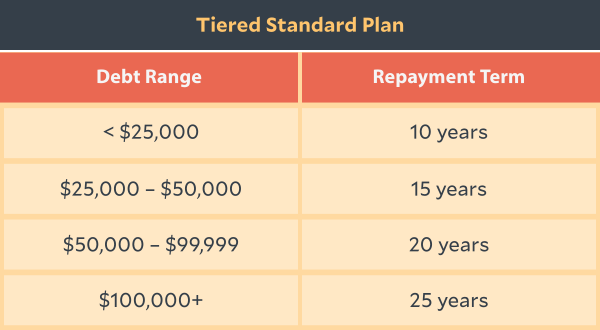
The Tiered Standard Plan offers fixed monthly payments, and bases a borrower’s repayment period on their total debt. It will also be the default payment plan. Starting July 1, 2026, students who exit school will be automatically placed on the Tiered Standard Plan.
RAP is Congress’s replacement for the existing suite of IDR plans. It has pros and cons when compared to its predecessors.
Whether RAP can help bring rampant delinquency under control remains to be seen. At the very least, it offers low-income borrowers a chance to stay current on their loans without drowning in growing debt.
In February 2026, ED publicly released nonpayment rates for post-secondary schools across the nation. This follows a May 2025 announcement advising schools to engage in proactive outreach to prevent default among former students.
Schools are only responsible for their cohort default rate (CDR), but delinquencies are fast becoming defaults. To combat this trend, ED advises schools to:
Congress has also taken action. OBBBA institutes several measures meant to ensure a student’s education debt can be paid off once they leave school. These include:
Taken together, ED’s guidance and the passage of OBBBA send two clear signals. First, the government expects higher education to pay off in a literal sense. Second, if schools want to remain eligible for federal loans, they must take partial responsibility for their students’ post-graduation success.
Borrower delinquency is at a crisis point. The government has revamped the repayment system and is instituting new oversight mechanisms. How can your school meet these challenges?
Student Connections recommends a proactive and sustained outreach strategy.
If you feel overwhelmed, don’t panic! Most schools don’t have the resources or expertise to provide a full-service counseling solution. Student Connections can help. Our proactive, default prevention services include:
Student Connections can run any aspect of your campaign at a lower cost than you might imagine. Whatever you need, we can help! Contact Student Connections today to learn more.
